

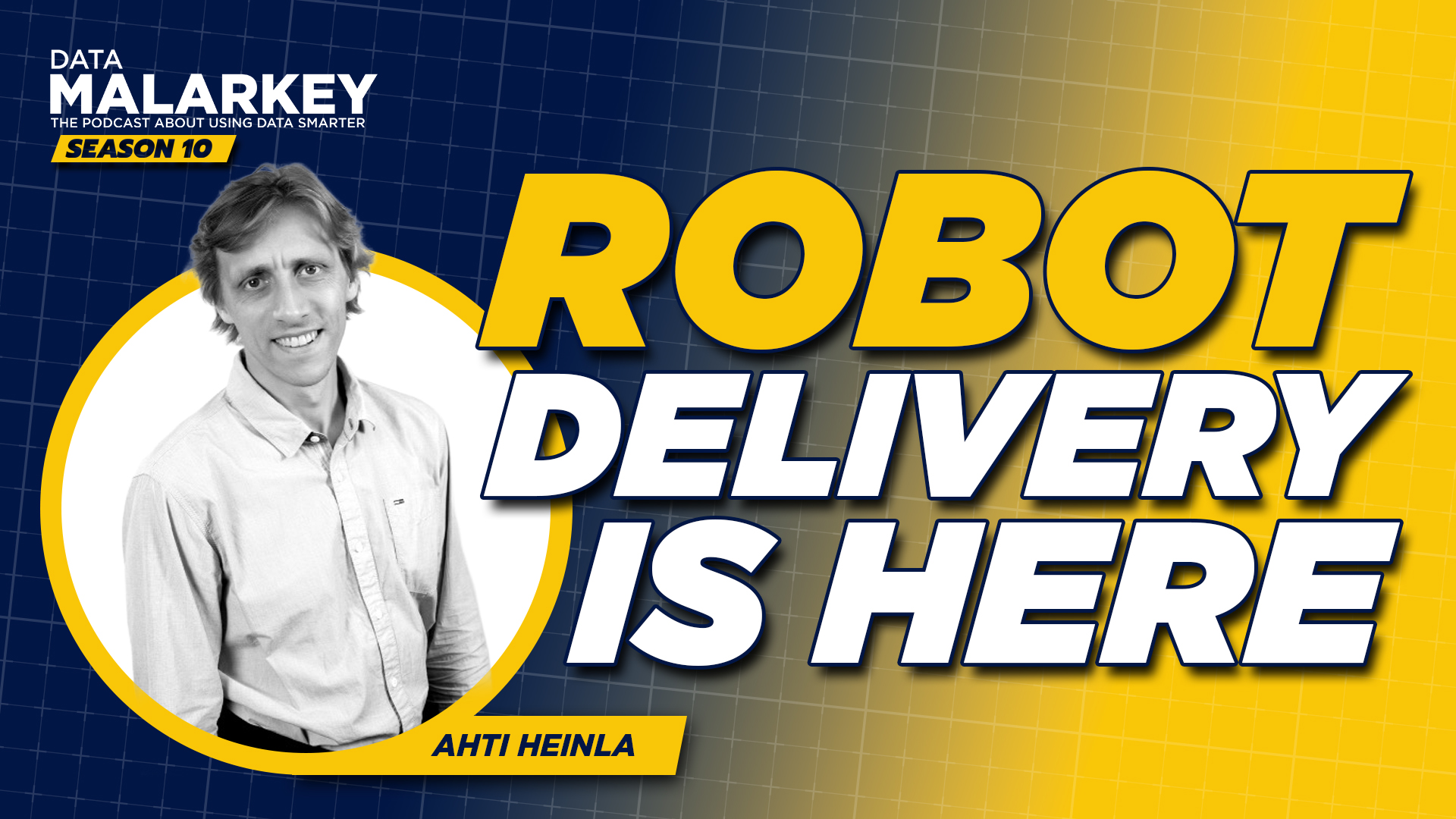
In this episode of Data Malarkey – the podcast about using data, smarter – Master Data Storyteller, Sam Knowles, is in conversation with Ahti Heinla, the Estonian programmer, serial entrepreneur, and co-founder of Starship Technologies. His career spans some of the most consequential software stories of the past quarter century, from helping to build Skype to leading the development of autonomous delivery robots now operating across Europe, the UK, and the United States.
What emerged from our conversation was not just a story about technical innovation, but a way of thinking: practical, data-led, and grounded in the belief that software should solve real problems.
Estonia’s “winners’ generation”
Heinla grew up in Soviet-era Estonia, where his mother, herself a programmer, taught him to code when he was still at school. He describes his childhood as a happy one, despite the political context, but he also places great importance on timing. Estonia regained its independence when he was 19, just as the generation above him began to rebuild the country. That “winners’ generation”, as he describes it, laid the foundations for the Estonia so widely admired: digitally advanced, administratively efficient, and an unusually fertile ground for start-ups – particularly tech start-ups.
That backdrop matters. Ahti’s own journey through gaming, telecoms, Skype, and robotics reflects a wider Estonian habit of using software to tackle practical questions. Why should signing a document require paper? Why should voting require a polling station? Why should the last mile of delivery still depend on a person carrying goods from shop to doorstep?
Solving problems we don’t know we have
Skype was one answer to a problem many people didn’t realise could be solved differently. As Heinla points out, its early promise was not obvious. Phones already existed. Most computers were desktops, and many had no microphone. Yet the product spread rapidly because it was useful, simple, and inherently social: you could not use it alone. You had to invite someone else. That feature created its own momentum, and Skype grew quickly enough to outpace the established telecoms players before they had worked out how seriously to take it.
Delivery robots and “the last mile problem”
Starship Technologies tackles a more stubborn problem, because it operates not in the digital space, but in the physical world. Delivery robots must deal with pavements, traffic, weather, regulation, and the sheer unpredictability of urban life. Heinla is clear that this makes the task much harder than building software alone. It also creates a greater barrier to entry. Starship’s progress – from early pilots with humans walking alongside the robots to large-scale deployments in multiple countries – has taken years of patient iteration.
The company’s achievement (and world domination in this space) is not simply technical. It is operational, regulatory, and cultural. Heinla notes that in Finland, autonomous robots already account for around 10 per cent of same-day last-mile deliveries – a country which is under metres of snow for many months of the year to boot. In places where Starship operates at scale, robot delivery is no longer futuristic. It is routine.
Joining the dots
What links Skype and Starship is speed, clarity of purpose, and a refusal to be overawed by incumbents. Heinla’s view is that data should guide decisions, not decorate them. One of Starship’s core values is that “data guides the way”, and he contrasts this with a wider culture that too often seems indifferent to facts.
That may be the most striking lesson from this episode of Data Malarkey. Heinla is not interested in technology for its own sake. He is interested in systems that work, decisions rooted in evidence, and tools that make everyday life a little easier. From communication to delivery, his career has been built on the same simple principle: find the friction, understand it properly, and solve it.
—
The first draft of this blog was written by ChatGPT, using a transcript of the episode and an ever-refined prompt. It was then edited by real humans.
Photo credit (C) Deborah Collcutt