

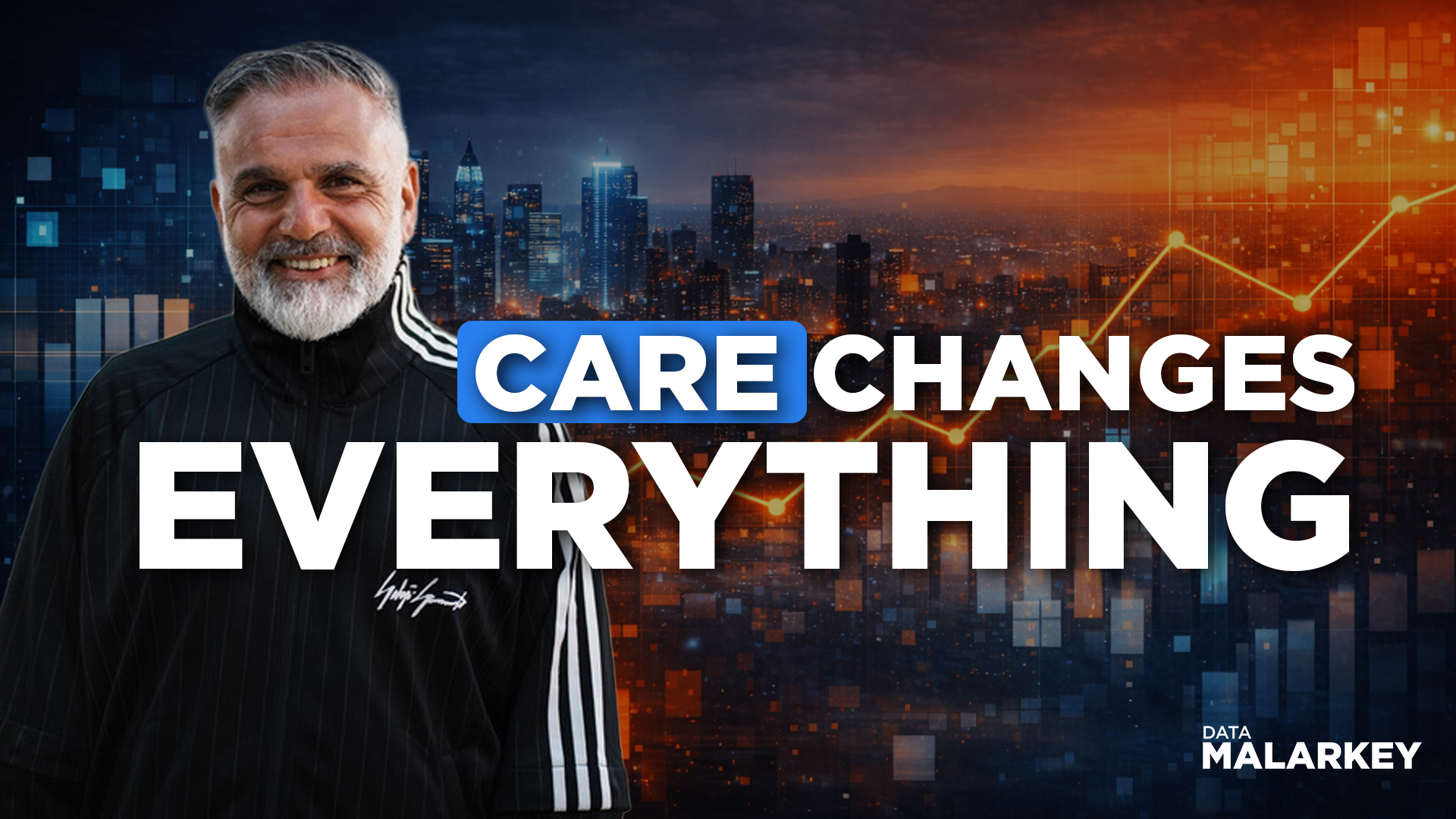
In this latest episode of the Data Malarkey Podcast, Master Data Storyteller, Sam Knowles, speaks to Judah Armani, collaborative designer, educator, and social entrepreneur. Their discussion focuses on how changing the way we organise information can change the way we understand, and ultimately solve, some of the world’s stubbornest problems.
Armani has spent much of his career working at society’s edges, exploring how design can reshape systems of justice, care, and community for people often overlooked by conventional approaches. His starting point is deceptively simple: design is problem solving, and problem solving is something everyone does.
A technique for producing ideas
For Armani, the process follows a broadly consistent path. First, gather information. Next, make sense of it. Then, specify an intention. Finally, act. The challenge lies in the crucial, difficult middle of sense-making: how people organise information determines what they can see.
Humans naturally put information into categories, or taxonomies. There are good reasons for doing so. Categories reduce complexity, help people communicate, and make systems and technologies work efficiently. But the same classifications can also constrain our thinking.
On taxonomies and classification
Armani contrasts two radically different approaches to understanding the natural world. The German polymath and geographer, Alexander von Humboldt, classified and named thousands of species. A century later, British writer, lecturer, and art historian, John Ruskin, argued, in effect, that there was only one species: nature. Neither perspective needs to be wrong. Each simply reorganises the same world differently, revealing different patterns.
That principle has practical consequences. A collection of films might be organised alphabetically, by director, location, budget, cast size, year, or even apparently incidental characteristics. Each reordering creates the possibility of spotting something previously hidden.
Searching for clues and traces in the margins
This is why Armani is drawn to hints, anomalies, and outliers. They are not necessarily evidence of a universal truth. Instead, they offer another entrance into a problem, another vantage point from which to look.
His definition of insight follows naturally. Rather than treating insight as definitive truth, Armani describes it as a “workable understanding”, something fluid and provisional that is true within a particular phenomenon, place, or moment. Good problem solving requires people to remain comfortable with what they know, what they know they do not know, and what they cannot yet articulate.
A case in point: In-House Records
That philosophy is embodied by In-House Records, the record label Armani founded inside the prison system. What began with a question, “Can I contribute to the reduction of reoffending?”, developed into an education programme that used the familiar structure of a record label to build creativity, employability, accountability, communication, and agency. Of the hundreds of inmates who have passed through the label, there’s a near zero level of reoffending.
Building creator redundancy into projects is a hallmark of successful creativity. That’s why, almost a decade later, Armani has largely designed himself out of the organisation of In-House records, itself a measure of successful social design.
Human insight in the age of AI
The conversation also turns to artificial intelligence. Armani sees considerable value in its ability to summarise existing knowledge but remains sceptical about its capacity for genuine creative divergence. AI is powerful inside the curve of what is already known. Human creativity is still required to move beyond that.
Summing up
Perhaps the most important idea running through the conversation, though, is simpler. Efficiency and convenience bring enormous benefits but can also strip away something essential: care.
Sometimes, smarter problem solving begins not by speeding up, but by slowing down, looking again, and caring enough to see things differently.
—The first draft of this blog was written by ChatGPT, using a transcript of the episode and an ever-refined prompt. It was then edited by real humans.